Programs Map Web cameras Photo galleries Webshop
Ecotourism

Programs
Events 2011
Demonstration areas
Useful information
Nature Conservation

National Park Directorate
Protected Areas
Our partner parks

Microsites
Usefull links

Search

Choose category

Tourism Accomodation


Nature Fauna

Cultural History

The Ethnography of the Hortobágy puszta

Introduction

"Ordained to stock-raising by nature" (Ecsedi, 1914.)

The largest puszta of Hungary is the Hortobágy, the most widespread, plain landscape of Central Europe, that has been ordained to stock-raising and herding by nature. The natural conditions favoured the development and perpetuance of such a stock-breeding culture that can be regarded as unique until the middle of the 20th century. By adjusting to the extreme weather conditions, stock-breeding, based on grazing in most of the year, also marketable abroad, kept those ancient species best fit for keeping and preserved the traditions of the herdsmen who tended the flock.

The peculiarity of the Puszta soon caught the attention for the early foreign travellers visiting our country and this region as well, while Hungarian poets and writers also recorded the beauty and uniqueness of the Hortobágy in their writings. According to our present concepts, one could say that the Hortobágy was discovered for tourism in the 18th century. There is no other region in this country that inspired so many folk-songs, poems, stories and artistic works, like the Hungarian Puszta. It has a library-size bibliography. The first regional monograph about herding was written about the Hortobágy by István Ecsedi in 1914.

The fate of the Hortobágy has always been a public concern. In the most difficult times, when "nature-transformers" were the masters of the situation, protectors of nature started to intervene. During the action of Pro Natura, internationally famous foreign and Hungarian scientists asked the Hungarian government in a memorandum to preserve the unique natural and ethnographic qualities of the Hortobágy. These initiatives resulted in the creation of the first and largest national park in the Hortobágy.

The Hortobágy-puszta becoming a regional unit

By the geographical name Hortobágy (puszta), we mean that plain part of Hungary that stretches between the loess table-land of the Hajdúság and the river Tisza. This area of 2500 square kilometers embraces the vast plain pastures of Egyek, Tiszacsege, Ujszentmargita, Polgár, Hajdúnánás, Hajdúdorog, Hajdúböszörmény, Balmazújváros, Debrecen, Nagyhegyes, Hajdúszoboszló, Nádudvar, Karcag, Kunmadaras, Nagyiván and Tiszafüred.

In public thinking, the Hortobágy of the present, as a geographical unit, has not taken shape until the 20th century. In 1914, István Ecsedi writes: "the real citizens of Debrecen do not go to the Hortobágy, but to the river of Hortobágy." Since the turn of the century, the plains belonging to Debrecen have also been referred to as the Great-Hortobágy, while the plain pastures of Balmazújváros were called the Little-Hortobágy.

So, the name Hortobágy means both a river and a landscape, and, since 1966, it is also a village of 2040 inhabitants.

The name Hortobágy is one of the oldest toponyms in Hungary. In the founding document of the abbey of Százd dated in 1067, it is mentioned as a dwelling place, where 20 Hungarian and 10 Pecheneg soldiers of the comes Peter lived. In the age of the Hunyadis, it is only referred to as a simple estate. However, the name of the river has always endured.

The etymology of the name Hortobágy has long been the concern of researchers. Most of them believes that the name is a combination and originally it only referred to the river. The debate has not been over yet. Up until the present day, it is the argument of István Ecsedi that seems to be the most convincing who revealed such a material of vernacular that is more acceptable than any former or subsequent argument. According to his theory, the main form of the word Hortobágy is bágy, that has already fallen out from the Hungarian language. It refers to such a wide, surface dip, maybe an aggraded fen of the Tisza, where the rainwater is accumulated, and after its evaporation, rich grass grows in its place. That phenomenon was called bágy in folk-speech. Two bágy toponyms are known, one is from Polgár, the other is the Bágy of Margita. The place of origin is the Bágy of Polgár which is joined by the waters Hollós, Hattyas, Bágy and Szandalik from Margita.

In depicting an organic Hortobágy image one could not neglect to review the former dwelling-places of the region. The first dwelling-places were the man-made barrows. Nearly two hundred "kunhaloms" (barrows named after the Cumanian ethnic group called "Kuns" in Hungarian), akin to the kurgans of the Great Russian steppes, prove that people have been living in these regions of the Hortobágy since the Neolithic period. These barrows were the watch-posts, dwelling and burial places of the nomadic peoples of the Great Migration. One of the east-west main roads passed through this land. According to Anonymus, at the time of the Conquest, the chiefs Szabolcs and Tas, with their troops, took this road to cross the Tisza at Dorogma to get to the Szihalom camp of Prince Árpád.

Presumably the Magyars were willing to occupy this area so suitable for stock raising. In the Carpathian Basin, settlements of the stock-raising Magyars were mobile for a long time. According to historiography, the consolidation of the settlements occurred during the 11th-12th century. In the regions of the Hortobágy, a close-knit system of settlements came about early. In possession of data from diplomas, Zoltai counted more than 30 smaller or bigger settlements from the Árpád-age. Almost half of those were ecclesiastic or church-places. It was a peculiar characteristic of the first conscious settling of Magyars that the compulsory church building, in order to confirm Christianizing, also secured the perpetuance of the village. Such settlements in the Hortobágy region were Hort, Bágy, Hahótmonostora or Ohat, Zám, Papegyháza, Derzsegyháza, Kócs, Szentmiklós, Fehérmargita (Szentmargita), Hetvenegyháza, Himes, Balmaz, Máta, Szabolcs and Csécs.

One could continue the enumeration with smaller settlements without a church or ecclesia, but the limitation of content does not allow that.

During the Árpád-era, several very small settlements emerged in Hungary. Many of those perished in course of time. Two important periods of desolation can be perceived. In the first one, development was accompanied by the depopulation of smaller settlements. The second is characteristic of the Turkish Occupation and the areas under Turkish rule. The first, the 14th-15th centuries, is the age of the great transformation of agriculture when the feudal estate system was consolidated and the stock-raising inhabitants of the country started to appear in the international stock market. The large-scale economic development necessarily entailed a sort of integration of the close-knit system of small settlements that emerged in the Árpád-age. It was a process where the more progressive, larger settlements absorbed the people of the more backward, smaller settlements. In the remote areas of the desolated villages, the puszta-tenements emerged, in other words the "szálláses", where the tenant-farmers settled for large scale animal husbandry. According to the bibliography, this process is considered to be the earliest period of the evolution of farm-steads. So the disappearance of small villages in this period should not be regarded as the result of some catastrophe, but as a natural consequence of the economic development. Those settlements around the Hortobágy that absorb one or two villagelets also outgrow the others. In this respect Debrecen takes a prominent role. The squire of the settlement was master Dózsa, Charles Robert's famous palatine, who also owned Máta and Zám. So these settlements were the belongings of Debrecen. In 1553, when the Transylvanian sovereign, Zsigmond Báthori donated the depopulated Máta and Balmaz-plains to Debrecen, he referred to the fact that the city had long been a peaceful and silent owner of Máta. At this time, the depopulated Hortobágy village already belonged to Máta. So the village can also be regarded as the first puszta of Debrecen. That is why it later became the center of the Hortobágy puszta.

The second part of the decay of villages is also a tragic period of Hungarian history. The settlements enduring the turmoils of centuries owe their perpetuance to their natural environment. Water is often a way of escape, the marshes; the reed-plots are often function as last resorts. The population often saves their livestock, their fortune and sometimes even their lives in the endless plain pastures, in the water-meadows and in the bushes. During the Turkish period, the most ravenous allies of the Turks were the tartars of Crimea, who raided the country in the 1590s. Ohat and Zám were also destroyed under the Turks. Debrecen was privileged with the status of a Free Royal Town in 1619. From this time on, it aimed to get hold of Ohat and Zám, too. The town seized Zám in 1671, and Ohat in 1680 from the Treasury as borrows; it leased them from 1808 and finally it succeeded in buying them on a perpetual price in 1854. With the properties Máta, Ohat and Zám, Debrecen dominated the Hortobágy area of 48,651 cadastral acres up to the Tisza. This area was first called Hortobágy puszta in the municipal records of 1701, and was also known as the Great Hortobágy from the beginning of the 1800s.

A considerable part of the pastures of the Hortobágy was owned by the neighboring settlements. In this regard, especially the growth of the hajdú cities verging on the puszta was significant.

The agriculture of the settlements around the Hortobágy started to decrease during the Turkish period. From the crop rotation they returned to fallowing and the once cultivated lands were reclaimed by nature. Our region was full of pastures in the 17th-18th centuries and shepherding in the Hortobágy was flourishing. This state affected the shaping of the settlements' appearance. The stock-raising culture of production resulted in the emergence of a peculiar settlement system. In literature these are called double inner-plot settlements or settlements with szálláskerts (~ where lands of the villagers is outside the settlement).

According to István Győrffy, the szálláskerts are equivalents of the auls of the pre-Conquest winter dwelling places. However, more recent studies regard them to be developments of the 16th-17th century, related to the prosperous export of the Hungarian cattle.

The utilization history of the Hortobágy

In the desolated lands of the Hortobágy the puszta-tenements were the first to emerge where the large herds of merchants and merchant-princes of Debrecen grazed in the 16th century. It is cited in text-books as well, that Gáspár Bíró, a merchant-prince from Debrecen, had herds of 10,000 cattle; and that the Duskás and Fekesházi families kept their herds in the expansive pastures of Csege. The numerous cattle of the masters were shepherded and driven to the fairs of Southern and Western Europe by herdsmen (hajdús) and by lads with huge sticks.

The Puszta was the external grazing-land of Debrecen and of the neighbouring settlements where the resting, unmilked, unyoked breeders were kept from the springtime driving-out to the autumn housing. Grazing was regulated neither by Debrecen, nor by the neighbouring settlements up until the middle of the 18th century. However, the increasing number of animals made it necessary to determine the right and order of grazing, and grazing organizations were formed. The pasture was first divided to districts. For example, on the puszta owned by the city of Debrecen, 11 districts of herds, 2 of oxen, 2 of studs, and 18 districts of sheep were appointed in 1774. Since the beginning of the 19th century, the grazing-rights have been regulated several times by the city of Debrecen. In 1878, it was ruled that any residents of Debrecen who did not own a house, but paid the taxes regularly, could take 5 neats or the corresponding 25 sheep out to the commonable pasture. Those with house and land could graze 8 neats or 40 sheep per 9,000 square-fathoms. Finally, the maximum number of the grazing stock was determined in a way that the landowners, irrespective of the size of their tenement, could not keep more than 184 neats or 820 sheep on the commonable pasture of the puszta, unless they paid fűbér (grass-pension) for the extra cattle. This regulation was in force until the expropriation of the Puszta in 1948.

In the middle of the 19th century, the city of Debrecen divided the pasture of the puszta to farms. The fact that the two waters, the Hortobágy and the Árkus, divides the puszta into three main parts, was considered as a starting-point. So, 7 farms were formed on this side of the Hortobágy, on the area beyond, and also on the lands beyond the Árkus (the one behind Máta, and those of Papegyháza, Hármashalom, Pentezug, Faluvéghalom, Halasköz and Sárosér). At the same time, the cattle-districts of the owner-community of Debrecen were situated on Macskatelek, Feketerét, Tornyidomb, Szásztelek, Szatmáritelek, Kungyörgy, Ludashalma and Derzsitelek. The farms and districts as economical units ceased to exist with the coming of nationalization, or state farms were formed in their places.

The Hortobágy Management Body was set up in 1879 to help to promote rational farming on the Hortobágy. The Management Body was made up of landowners and it had an opinant, proposing role as opposed to the municipal council.

Máta became the centre of the puszta-farms. The office-bearers, the veterinarians, the commissioner of Máta and the gendarmes lived there. The commissioner of Máta was the most respectable man in the eyes of the shepherds, although the municipal councillor had a higher position.

In the classic home of herding extreme weathers were impermanent. Apart from the rare droughty years, the grazing cattle have always had more than enough to eat. However, after the regulation of the Tisza, the fruitful floods that had been watering the sod failed to occur any more and the quality of the pastures started to decay. The owners from Debrecen complained: "Since the regulation of the Tisza, our saliferous grazing-field, not fertilized by the floods at springtime, is getting less and less usable and even in case of favourable weather our farmer public can only keep its cattle out there until July at best, and the once fat grazing-fields become totally barren by July and the cattle do not find enough food there."

The most important concern of the utilization of the Hortobágy is the supplementation of water. Projects of watering and channelling were created. The idea of establishing fish-ponds emerged as a method of amelioration. But the town having debts because of the fin-de sičcle large-scale public projects could not provide money to solve the problem of the utilization of the puszta. The fate of the Hortobágy remained a public concern though. The owners considered those plan to be acceptable that served the purpose of stock-raising. Thence the plan of more intensive shepherding accompanied by breed shifting was dismissed, saying that only the Hungarian Grey Cattle is fit for the cheap, grazing stock-raising.

The plan of flooding the Hortobágy and consequently the plan of establishing fish-ponds did not disturb the traditions of shepherding in the Hortobágy. The spot where the fish-pond was designed to be put was on the least fertile land called Csúnya-föld (Bad lands). The enterprise of the fish-pond was taken by the Haltenyésztő Rt. (Fish-farming Inc.) in return for 10 years profit. The constructions started in 1915 but it was not finished until 1921. The then largest system of fish-ponds of Europe received the invigorating water from the Tisza through a 24 kilometres long artificial canal. However, since 1948 it has been connected to the water-supply of the Western Trunk-main built from Tiszalök together with the other fish-ponds (of Ohat, Derzs, Csécs, etc.). The establishment of fish-ponds was accompanied with the development of a particular branch, that of those specialized in fish-farming. The pond-farms employ 4-500 people a year from the neighbouring settlements. Fish-ponds grow reed in great quantities. The reed-fabric, an important product of the building-trade, has led to the establishment of reed processing plants, where the number of reeders reached hundreds. In a time the typha was selling well. People of Tápé, Bősárkány, Biharnagybajom and Tiszavalk who were doing matting and meshing typha for a living got the raw material from here.

Afforestation in the Hortobágy was also planned from the 1880s. Forests of 3-5 acres were planted only to protect the cattle. Planting was more successful by the roads and rivers.

Rice-growing was also attempted. The experimental growing was started on 4 cadastral acres, on the lands of Máta in 1936.

For the purpose of establishing experimental farms 3789 cad. Acres of land on the Belső-Ohat (Inner Ohat), near to the commonable pasture, and 550 cad. Acres of land on the Külső-Ohat (External Ohat) were arrented to the state in the crop years 1943-44.

By the nationalization of 1948, a new era has begun for the utilization of the Puszta. Debrecen was totally excluded from its age-long heritage. The pusztas of Darassa and Papegyháza were annexed to Balmazújváros, on the area of Külső-Ohat Telekháza was established as a part-settlement of Egyek. On most of the empire of the "cívises" of Debrecen, the National Trust of Animal Husbandry of Hortobágy has started the organization of state farms. The Centre of State Farms of Hortobágy was formed in 1950. The State Farm dealt with grazing animal husbandry for a while, but it was also engaged in enlarging fish-ponds, the size of which reached 5576 ha. by 1983. The size of plough-lands was increasing too (eg.: as an experiment, rice was grown on 6,000 ha.). Attempts were made in planting new forests. Among the branches of traditional animal husbandry, shepherding, with its centre built in Darassa, was almost the only one that survived. It was the initiator of establishing the village of Hortobágy, where the workers of the Farm who had been living in different places could find better living-conditions. It has an important role in building the irrigation system of the Eastern and Western Trunk-mains. The duck- and goose-farms appeared on the Hortobágy in the time of the State Farm. However, the stocks with ten thousands of animals endanger the ecological balance of the area. Fundamentally the State Farm has proven to be an unsuccessful experiment. It meant the downfall of the idea of the giant-farm since it never succeeded in embracing the whole area.

The political change resulted in the privatization of a significant part of the state property. Then the fate of the State Farm of Hortobágy was questioned. First the Fish-farm of Hortobágy became independent in 1989 and it was turned into an incorporated company in 1992. The State Farm was liquidated in 1995 and the Public Utility Company for Nature-conservation and Gene-preservation was formed on its territory of 22,000 ha. The PUC is a managing body with a nature-conserving approach, as the name indicates. The PUC keeps herds of Hungarian Grey Cattle and buffaloes, flocks of Racka sheep and herds of Mangalica-pigs with the purpose of gene-preservation. The progeny is sold in home and foreign markets as bio-products. It is very important to have a co-ordinance between the market-oriented PUC and the state-financed Hortobágy National Park in the protection of nature.

The Hortobágy National Park commenced in the territory of the State Farm in January 1, 1973, on an area of 52,000 ha. With the continuous enlargements, this area now reaches 80,000 ha. that serves to preserve our unique natural and ethnographic values. The whole territory of the Park is a biosphere reserve that, according to the Ramsar Convention, is an internationally registered wetland habitat of 20,000 ha. In 1999 the UNESCO granted the title "Part of the World's Heritage" to the area. The HNP, while working on the restoration and conservation of the natural landscape, protects the monuments of folk architecture on the puszta, and by the almost symbolic leasing of the pastures it supports the practice of traditional grazing animal husbandry and the re-naturalization of ancient breeds. It takes the responsible task of improving the image of the geographically organic Hortobágy from the aspect of the traditional animal husbandry.

The Lovasfalu (Equestrian Village) is an interesting world in the Hortobágy. The EPONA Ltd., bearing the name of the god of horsemen, built the village unique in Europe on the 34 ha. area near to Máta that was bought from the State Farm in 1992. The village is partly built on the river Hortobágy with 21 independent buildings (originally 84 was planned). The houses are self-contained with their own stables. Their studs mean the top of breeding sport-horses. The native horse of Hortobágy, the Nóniusz, is also bred here. The qualified horsemen perform successful horse-shows abroad and in Hungary as well. The Hungarian public accepted the project built on home and foreign capital costs, with mingled feelings: it is considered necessary, but irrelevant in this area.

Fishing the waters of the Hortobágy

Three rivers of the Hortobágy is considered to be important: the Hortobágy, the Árkus and the Kadarcs. As a fourth one, the Tisza can be mentioned even if it only touches the north-western corner of the Ohat puszta by a 1200-metre-long stretch. Besides these, several natural ponds and streams could be found in the area before the river regulation, which served as fishing places. Among these, the Herep, the Nagymorotva and the Völgyes should be mentioned as the most important ones in the outskirts of Ohat.

The river Hortobágy is the most important fishing-water that is fed by the outflows of the Tisza and wild-waters. The diploma from 1248 refers to its former importance mentioning the donated fishing-place by the road to Böszörmény crossing the river. In the Middle Ages, the upper and middle parts of the Hortobágy river belonged to the villages Máta and Balmaz, while the lower part belonged to Nádudvar. János Hunyadi was the first who gave Máta and Balmaz into the use of Debrecen, together with the fishery. Later Zsigmond Báthory, the prince of Transylvania confirmed the fishery rights of Debrecen on the river. The fishery of the city on the river prevailed from Papere to Sárosér.

The Árkus was also a good fishing-water in the 18th century. It drained the water of the Völgyes into the Hortobágy, and through the Szántásfoka it was in connection with the Tisza as well. The excavation of the linking trench for draining away the water and feeding the fish was ordained by the city of Debrecen at the beginning of the 18th century. According to the people of Csege, the Árkus was the water that the raftsmen of Máramaros used to transport salt and timber to Nádudvar when the Tisza was high.

The Kadarcs, meaning cranky, sullen water in folk-speech, divides the Hortobágy puszta from the estate of Elep. The people of Újváros used to fish this water; at the beginning of the 18th century they had a big fishing-box here.

A short stretch of the Tisza was annexed to the city of Debrecen together with the estate of Ohat. The river has always attracted the fishermen of Debrecen and was frequented in the hope of a good catch already in the 17th century. However, it was a dangerous sport even for those fishermen protected by the Turks. It happened in 1638 that János Törösdi and Ferenc Szentpéteri, or Callistus "while going to the village named Csege for fishing, were captured by the Turks of Eger, whence the senator Benedek Csontos could ransom them with great difficulties."

The three best ponds full of fish, the Herep, the Nagymorotva and the Völgyes have often been mentioned as donations since the Middle Ages. The Abbey of Ohat owned half of the Völgyes and the Nagymorotva, the other half was used by Csege. That is how it went to the ownership of Debrecen.

Among the several ponds and streams of the Hortobágy, the Papere, the Karácsonyfok, the Fényestó, the Bodajcs-ere, the Sebesér and the Sárosér were mentioned as fishing-waters by the documents. Nevertheless, these waters were only interested in fishery in the watery years. The shepherds grazing nearby reckoned with these waters, and they often fished them with the kétköz (a kind of fishing net). From the toponyms such as Csukásfenek (Pikey-bottom), Compólapos (Tench-shallow), Halasfarka (Fish-tail), Halasrét (Fish-meadow), Csíkos-ér ("Loach-brook"), one can only infer that these could have been fishing-waters kept in mind only by shepherds.

The fish-stock of the waters on the Hortobágy puszta depended on the weather. While the Tisza rambled the land freely, it also provided the supply of fish. After the regulation the waters of good spawning-grounds, ponds and brooks dried up and the significance of fishing in the waters of the Hortobágy also declined.

In the Middle Ages, Debrecen had fishery rights only on the Tócó, where the sealed warrant of the magistrate ensured the inhabitants' fishing free one day a year. The fishing of outlying waters of the Hortobágy was prohibited, since they were utilized by leasing. However, at the beginning of the 18th century leasing was suspended for a while in hope of a bigger income. The city bought nets and employed conventional fishermen. The fish was sold in the fish-shops of the city. In spite of the tight control, the fishery did not prove to be profitable, and the expenditure was not returned. So, since the middle of the 18th century they have been attempting to utilize the waters by leasing again. But then the magistrates and the town-councillors who utilized it in sub-tenancy took the right of lease and they did not change this practice despite the inhibition by the town. Probably that was the reason why the city started to sell the leases of fishing places at auction sales from the beginning of the 19th century.

But no one cared for domestication of fishes; the main concern was to make profits. When the Tisza did not provide the fish-supply, the fish-stock gravely decreased. The profit of fishery was only 28 Forints in 1841. Because of the low profits, the council gave up its former practice and attached the lease-rights of fishing-places to the lease of the Inn of Máta (Nagyhortobágyi Csárda) in 1846. This measure has prevailed until 1945. Lately, the leaseholder of the inn has fished only the river Hortobágy by independent fishermen.

The municipal council repealed the contract in March 1945. Then it agreed with Károly Varga and Sándor Sipos from Debrecen that in favour of bettering the conditions of public catering "they are obliged to set all the fish up for sale in Debrecen in order to provide food for the population". The contract has not expired yet when the statutory rule 6700/1945 came out and the fishery rights of all the waters escheated to the state.

Grazing animal husbandry on the puszta

Breeds and herd-organizations

Cattle herding on the Hortobágy was practised in the traditional way, even at the beginning of the 20th century. As it is recorded by István Ecsedi in an almost dramatic manner: the cattle usually kept poorly in the winter lives under the open sky of the Lord from springtime until the autumn; it does not have sufficient forage and water to drink during the often dry period; the primitive resting-places do not provide real protection, it has to lie on the muddy, cold ground; and the hot sun also tells upon men and cattle as well. So such a breed should be kept that is able to bear all kinds of difficulties. Only the Hungarian Grey Cattle was adapted for being raised on the Hortobágy puszta.

It was a long-lasting belief that the Magyars of the Conquest brought this breed with themselves, and later the Cumanians were believed to be the ones who naturalized it. However, it seems more probable that this race was bred here, in the Carpathian Basin. The smaller cattle brought by the Hungarians was cross-bred with the large, ancient steer found here. From this aspect, the term "Hungarian Grey Cattle" is justified. A Transylvanian variant of the same cattle was known and, at the turn of the century, a bluish-grey, so-called kun (Cumanian) breed in the Kunság was also recorded.

The situation of horse-breeding was different though. The community of Debrecen kept horses for a long time past. The first traces go back as far as the end of the 17th century. That was the first base-stud of the town and was kept to provide the town with work-horses. It was a rather mixed stud, mostly of small, but hardy horses. In the stud renewed in 1773 noble breeds were also tried out, but without much success. Later, in 1828, when the next stud was established, horses, mostly Spanish breeds, were bought from well-known studs. The real breed-shifting has not come about until 1885, when the town's stud was out-bred by the Nóniusz horse. This breed became world-famous at the beginning of the 20th century.

The most ancient breed of sheep of the Hungarians is the curly, long furred Racka. On the Hortobágy it was called "riskás". The extremely hardy Racka sheep disinclined to disease endured the hardships of being kept on the Hortobágy; sometimes the flock was out on the puszta during the whole winter. Several varieties of the Racka were known, for example the Racka of Hortobágy (Ovis strepsiceros Hortobagyensis) that was kept all over the Alföld (the Great Plain) and in the Bakony, too. The buck and the female sheep both have upright, tip-tilted, twirled horns and this kind is called "Hungarian sheep" by the Gorals of the Tátra-region. The other is the Transylvanian Racka that has slightly twirling, horizontal horns, though the female sheep usually does not have horns. "Purzsa" or "purzsás" sheep were also recorded on the Hortobágy, which came with the shepherds leasing the pasture.

The great change in sheep-breeding came with the appearance of the Merino sheep of Spanish origin which has flossy wool. From the end of the 18th century its spread was helped by the wool business, because the coarse wool of the Racka did no longer meet the requirements of the merchantry. In the beginning the farmers loathed it because a formerly unknown disease accompanied it, the follicular mange. The first flock of Merino sheep on the Hortobágy was kept in the very corner of the pasture, by the bounds of Angyalháza, on the Téglahát, almost in quarantine. It was not even called juh (sheep), only birka. Because of its fastidious nature, the Merino required thorough attention. It was cotted and kept on fodder during the winter. One had to be careful during the Merinos' fall as well. By the end of the 19th century the kétnyiratú (double chip) Merino thoroughly outplaced the native Racka breeds because of its precious wool and its being a heavy milker. The keeping of Merino sheep prevailed all over the Hortobágy.

In this land the szalontai or réti (meadow-) swine are considered ancient breeds. But the Mangalica that is more inclined to corpulence and gives tenderer meat outplaced this breed by the middle of the 19th century. However, the Mangalica is a fancy breed, a cross-bred of the Serbian sumádia and the Hungarian Bakony swine.

The livestock all over the Hortobágy is numerous in every period, although it never bore proportion to the vast area of pastures. Exact data concerning the number of the grazed animals are available from the 1860s. The highest number of animals was recorded in 1880, when 17,811 cattle and horses, 27,971 sheep and 9,610 swine, in total 55,492 animals were counted. This number concerned the livestock of Debrecen and its owner-society though. The livestock of the neighbouring settlements grazing on the areas of the Hortobágy should also be added, because these pastures belong to the puszta as well. So the number can be as high as 200,000.

The grazing animals appear in certain units in extensive breeding. These units are called nyáj (herd or flock) in short, which is a word of Turkish origin and identical with the term "to graze". In the old Hungarian vernacular, in the Hortobágy as well, the terms lónyáj, nyájasló (flock of horses) were in use, but later this term was confined to refer to sheep only. The falka, darab, tőke represented smaller units inside the flock, meaning livestock-units belonging to certain owners. The concept ünöm has become extinct in our language, yet it should be mentioned because ethnographers discovered it on the Hortobágy in the 1930s. It refers to a bunch of animals of different ages, but from the same parentage.

The number of animals in a flock is varied, it depends on their species, the size and quality of the pasture and the water supply conditions? The stud, the herd comprises an average of 500 animals, but can be three times as much, too. The number of the swine and the infecund sheep can be similar, but the flock of milch-ewe is usually much smaller since the shepherd has a lot of work with milking. The number of the hired shepherds depend on the size of the flock. In case of horses or cattle, every 100 animals take one herdsman. The swine and the sheep can be managed with fewer shepherds.

The shepherds of the Hortobágy

The shepherds of the Hortobágy form a determining part of the traditionalist community that the ethnographic literature calls "the shepherds' order". In case of the Hortobágy the shepherds were carriers and vivifiers of a particular culture more archaic than that of the peasants until the middle of the 20th century.

The order of pasturing on the Hortobágy puszta and the specific shepherds' society had been developed by the 18th century. After that, the municipal council and the community of owners hired the shepherds.

In the beginning most of the shepherds were from Debrecen, e.g. from the 83 shepherds listed in 1783 49 professed themselves inhabitants of Debrecen, 22 coming from the neighbouring villages and only 12 came from more distant regions. However, in 1914 Ecsedi wrote that the shepherds of the Hortobágy were not natives of Debrecen, but most of them were from Polgár, Tiszacsege, Egyek, Nagyiván, Tiszaigar and from Nádudvar.

According to the inexpert public opinion, all of the shepherds are situated on the very bottom of the hierarchy of the village society, right next to the servantry. This opinion is only true if the village herder and swine-herd are considered. On the other hand, if we examine the shepherds' society more thoroughly, it turns out that during feudalism not only cotters, but also sons of landowners and armalis nobles could also become shepherds. Because the manors, and especially the town of Debrecen and its owner-community, would not have committed the valuable livestock to the care of penniless, wanting people, it trusted people who had some wealth and some livestock of their own. Naturally, such requirements concerned only the számadó (the leader of the herdsmen) responsible for the animals. The bojtárs (herdboys), on the other hand, were hired by the számadó and he answered for them. "While the herdboys are often really wanting people, the számadó always comes from a respectful family, the crested shepherds are coming from dynasties."

Choosing the számadó required real circumspection. His hiring was almost solemnized by the owners. Sándor Vigh, a leader of herdsman, told the story of his hiring in 1941 as it follows: "I visited the first owner, the squire István Némethy, before Christmas. I told him what my errand was: "I would like to take a flock of animals." He asked me how I am off for money. When I told him, he answered: "Hey, I'm gonna bear you in mind." I also visited another owner, Ferenc Nyilasi, but he wasn't half as kind, 'cause he snapped at me: "Well buddy, what do you want?" So I realized that he had already picked his man. The számadó selection was held on the second day of Christmas. We gathered in the owners' reading circle. There the court-crier cried out the names. My name was cried as well. I went in and stopped before the long table where the owners were sitting and they eyed me up and down. First, they interrogated me and I could leave. Then those up to the mark were called again. They informed us which cattle or stud we were going to be számadós of. The wage was also told. We could not argue over it, because many people competed for one place. In 1941, my wages were 2,000 pengős, 10 kilograms wheat and 5 decagrams lard per animal. Afterwards I decently bowed and they said: "Good luck, be a real man and hire good herdboys!" Outside, the companions waiting there immediately asked: "Well, is your bag heavier now?"

The hired leaders gathered at the pub named "Háromzsidólány" ("Three-Jewish-Girl"), by the Kisállomás (Small-station). Here they met those companions whose bag did not become heavier. Usually, the herdboys were selected from them. The time of their actual hiring was the fair on the 20th of January. The little-herdboy was selected from the children of the relatives at home.

The shepherds' society had a hierarchic structure. The most respectable is the számadó, the leader (called bacsu in case of sheep) who answers for the livestock he is trusted with. He commands the herdboys, his word decides. The next is the számadó- or old-herdboy. Similarly to the leader, he is also a married man, with a little property. The herdboys are young, unmarried men, before the military service. The little-herdboy and the tanyás (~ stead-keeper, carter) are children. This hierarchy is also represented in the wages. The daily grazing and watering is done as the számadó assigns it. Only the tanyás's task is different. He is the one who cooks and takes the dinner out to the cattle-camp, he guards the fire in the vasaló (herdsman's hut), and tends the "shepherds' fire" during the late autumn grazing to guide his companions in the darkness.

The rank of the shepherd also depended on where he served. The shepherds of the Hortobágy ranked the highest, because "the real shepherd served the town of Debrecen". The others follow him, the village herder and the swine-herd are at the bottom of the ranking.

In this society the kind of livestock one was herding also influenced the shepherd's ranking and prestige. Keepers of valuable large-animals (horses, cattle) were held in the highest esteem. There is hardly any difference between the csikós (rangeman) and the cow-herder. The rangeman outstands because of his stiff-neck and pride and the fact that the horse is a valuable animal, sprightly but can be easily injured and its driving wants an experienced, skilful man. In possession of such talents, it is no wonder the rangeman was esteemed high. In the 1930s, "Count" János Czinege of Nagyivány and János Kardos from Böszörmény, who wrote a book about his memories of being a shepherd stood pre-eminent among them. But the cowherd was by no means inferior, because he also rode a horse and the cattle was also valuable. In the Hortobágy region the cowherd has the longest history among the herdsmen keeping large-animals. Occasionally, he herded horses together with the cattle. In the novel "Yellow Rose" by Mór Jókai, the cowherd is presented as a man of energy who is determined, but also calm. The shepherd (sheep-herder) is the "Háry János" (~taradiddler) of the herdsmen. He is a great storyteller. He has time to dabble in art by the flock of sheep (not in case of milch-sheep) and they really excel in shepherds' art. Many of them could gather a little wealth by herding. During the 19th century, the magatarti (those who had their own stock as well) shepherds were deriving from among them. Keeping the swine out on the pasture during summer and winter tried the swine-herd real hard. He was condemned to loneliness without any chance to converse or to bedizement.

Keeping a tally of the stock

"In the springtime, at the driving,
Any squint-eyed can be a herdsman.
But in the autumn, at the tightening
Those who count are the herdsmen!"

The herdsman's work started with counting the animals before driving them out to the pasture. The illiterate, innumerate shepherd had to be familiar with "tallying". The tally-stick (- a wooden stick to be carved on) was used for this. Tallying was kept on tetra-, hexa- or oxagonal tally-sticks according to owners, where the numbers, which resembled to Roman numerals, were carved from right to left by a jack-knife. One end of the tally-stick was the head where the owner's sign was carved. Increase was carved onto the tőkerovás (~stock-tally) divided by a line from the other numbers, while the number of perished animals was carved onto the dögrovás (~carcase-tally). In order to prevent the forging of the tally-signs, they invented the párosrovás (double-tally) that meant the splitting of the tally-stick to halves. One half was given to the owner and the original score could be checked at the autumn driving-in by joining the two halves. The old shepherds knew the practice of tallying even at the beginning of the 20th century, but then it was replaced by the flock-books (irkas).

The identification of the stock by its owner was helped by means of earmarks and branded property marks (bilyog). However, a worth-while shepherd could tell it by the animals' natural marks and characteristics "because, as two identical men do not exist, the animals are also differing from each other". The colour, the shades of colour, its poise, its age, the shape of the horn, etc. are often more telling signs than the otherwise forgeable, "blemishable" marks. The earmarks were mostly used for sheep. The different marks on each ear provided great variability. Each had different names (rózsás, ájos, etc.). Earmarks were used all over Europe. Nevertheless, the owner recognized his own cattle, which had grown since the springtime driving-out, more easily by the branded property mark. If the animal had perished, the shepherd could more easily account for it with the branded furs. The bilyogzó (the marker) was made of iron and by heating it the shepherd pressed it onto the bottom, or sometimes the neck, of the animal (usually cows, occasionally horses). The word bilyog of Turkish origin let us assume that the Magyars of the Conquest had been familiar with it. Because of the spreading cattle-lifting, its usage was regulated by enactment from the 18th century onwards. The branded property mark usually represented the initial letters of the owner's name. The letters "DV" were applied on the stock of the town of Debrecen. The shepherds also used the so-called "szoktatójel" (habituation sign) that represented horse-shoe, sickle, hammer, etc. and were made of wood. These were twin signs, one of them was hanging on the suckler, the other on the lambkin and it informed the shepherd which one was the mother of the little lamb. This practice of marking was brought to Hungary and to the Hortobágy together with the Merino sheep.

Shepherding the flock

It was the shepherd's natural obligation to save the stock, even if it costed his own life. In the 18th century shepherds were already provided with arms against the wild beasts, but they could also use it against the cattle-lifters and marauders. The point was not to let the stock driven away. It was easier to defend the flock against the wolves. One had to know well the practices of evil-doers: how to force the stud, the herd to run away by smoking cow-nail, hair or foot-rag in the pipe. That was the easiest way to "purloin" the stock.

The larger is the stock and the smaller is the pasture, the more difficult is to shepherd it. When there is heat, the flock gets full of "bugs" because of the parasites. When there is thunder and lightning, the flock comes asunder. The stock had to be guarded against the mosquitoes by smoking.

The bell and the cow-bell (csengő and kolomp) were to keep the flock together. All the animals follow the one with the bell in the neck. The shepherd hanged a high- and sharp-sounding bell onto the stirring animal inclined to wandering. The cow-bell (kolomp or "harang") suits the cattle, the bell (csengő) suits the horses. The ram gets a kolomp in the flock of sheep, while the dog receives a pergő (a smaller, sharper-sounding bell).

The most important tool of shepherding is the stick. The rangeman does not use it. The shepherd makes himself it from the offshoot of a chosen oak, dogwood, plum- or pear-tree. In order to produce a nice, rugged stick, the shepherd hacks it with his knife one year before cutting. After cutting he ripens it in dung, he "reddens" it. He also besmears it with white lime and lard to make it shiny. It is not only a tool of shepherding, but a throwing-weapon, a seat when held between the legs, and it gives a shadow from the sun when stuck into the ground and covered with the felt-cloak. It has two types: the formerly described one is the bunkósbot (bludgeon) and the other is the kampósbot (hooked stick) used by the shepherds. The hooked stick is used to fish out a sheep from the flock. The other important tool of shepherding is the whip. That has two types as well: the long-shafted one used by the wagoners and the short-shafted karikás ("ringed-whip") of the shepherds.

The pányváskötél (noose) is used to fish out the unruly animal not accustomed to man. In the neighbouring Kiskunság (Little-Cumania) it is called árkány. The 8 or even 14 metres long noose was formerly made of horse-hair but later it was made of hemp by the cord-maker. On one end there was a ring, and the loop was made roven through that. The chosen animal was driven against the well at the time of watering and the noose was thrown onto its neck. Because of the horns, rudaspányva (pole-noose) was applied to cows.

The well-trained saddle horse was a real companion of the rangemen and the herdsmen in driving and shepherding the flock. The counties prohibited the shepherds' use of saddles until the middle of the 19th century. That is why the so-called "rangeman's saddle" was invented: a rug (patrac, priccs) over the horse's back with the stirrups hanging on a single strap. The shepherd's companion is the donkey that was used rather as a pack animal and not as a shepherding one. The shepherd without an accommodation made a kind of wooden saddle similar to the sawyer's trestle that was called tergenye. He put his clothes and his most important tools onto it. That is why this animal was called "clothes"- or tergenyés donkey on the Hortobágy.

The clever shepherd dogs also played an important role in guarding the stock. Two kinds can be distinguished: the larger-bodied guarding-protecting komondor and kuvasz and the smaller-bodied driving dogs, the puli, the pumi and the mudi. Documents from the 16th-17th century referred to the komondor as the Cumanians' dog, and to the kuvasz as the peasants' dog. Both of them were kept against wolves and later they were used as the guard-dogs of farmsteads. The clever puli, that has excellent talent to drive the flock, was primarily kept by shepherds but the herdsmen also used it. The kuvasz and the komondor are autochtonous, while the puli did not appear until the 18th century and its appearance can be connected with the naturalization of the Merino.

Watering and salting

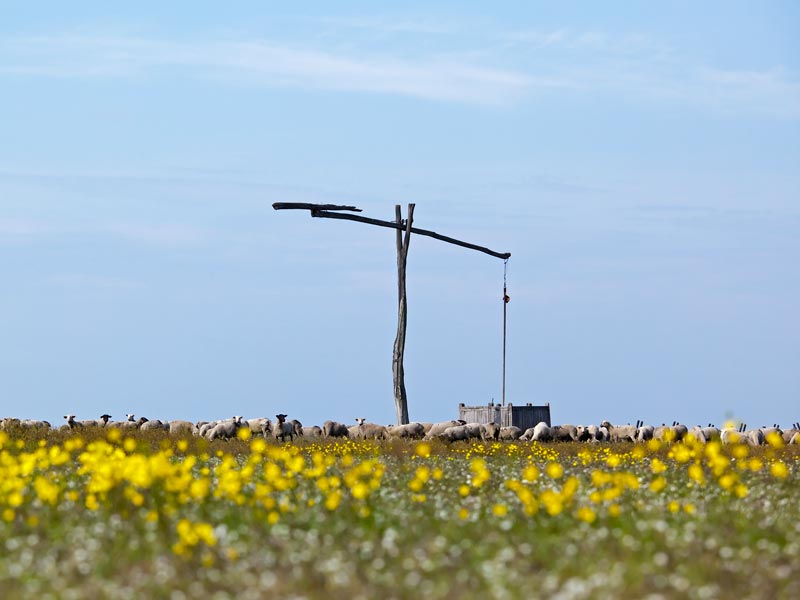
The grazing animals had to be watered. The horse is the most sensitive to water, so it had to be watered from the well, or formerly from streams or rivers, like the Hortobágy, the Árkus or even the Tisza. The other animals could be kept on still water. Before the regulation, in times of dry weathers the shepherds dug "mud-wells" into the beds of extinct ponds. This kind of well was rectangular and its opposing sides were sloping to help the animals reach the water. While the ground-water was high, the shepherd dug a 0.5-1 meter deep "kopolya" (a kind of small well) for his own use and sipped the defecated water through a reed-sipper from it. The dug-wells spread all over the Hortobágy by the end of the 18th century. Rush, hedges or boards fettled these, but since the 19th century burnt curved brick, so-called "well-brick" was used. The wells were large, their perimeter could be as large as 4 meters in order to let more buckets used in them simultaneously. From the wells with two-three-four sweeps the shepherds drew the water while standing on a plank over the well when watering the animals. It was a hard work to water a numerous cattle. The four-sweeped well of Faluvíghalma with its carved, caged forked upright was very famous. Although the Hortobágy was full of wells, potable water for man was hard to find. The water of the dug wells was mostly kind of reddish, iron water. In 1874, even bitter water was found during well-digging, which was later sold as medicinal water by a wangling merchant from Debrecen. The landowners of Debrecen believed that only the sinking of artesian wells could solve the problem of the supplementation of drinkable water. 6 artesian wells were established since the end of the 19th century. Because of its temperature (35.5 C°), the well sank in Máta in 1914 became famous.

Because of physiological reasons, it is necessary to fill the need of salt of the grazing animals. That is the shepherd's task. The kűsó or marhasó (rock-salt, cow-salt) was put on a pole by the well or into the salting-manger for the animals to lick it to their liking. In the 18th century the salt was believed to be the cure of cow-plague. If the animal's rumination stops, it can be restarted by giving it lukewarm salt-water to drink. In case of need the animals licked the native soda as well.

Curing

The Hungarians, being a stock-breeding people, were acquainted with curing animals since the ancient times. It is true though that the nomadic extensive pastoral culture did not pay too much attention to the curing of animals. It was not considered a great problem if a few perished and, on the other hand, those animals were hardier than the ones accustomed to stables. However, coming from a family with a long shepherding tradition, where the knowledge of curing was also handed down, weighed heavy when hiring the shepherds of the Hortobágy. So, the well-tried remedies did not miss from the dispensary of the shepherd. Since the spreading of the Merino sheep, they have known how to cure the mange, with the so-called mange-ointment made of mercury, turpentine and tallow. The vaccine against smallpox is taken from the wound of the diseased animal by a quill and is scratched onto the other animal. It is a great trouble, when the sheep "goes mad" and starts spinning around. Then the shepherd applies trepanation on the forehead of the mad animal where it softened and removes the nidus of the worms that caused the madness. The most frequent disease is when the animal gets the myiasis. In this case the starling is the best surgeon, but the shepherd can also winkle out the worms with a needle and besmear the wound with dung. The lousy calf is cured with mud made of white clay that is besmeared on it, the shepherd lets it dry and then it is chipped off with the lice stuck into the mud. Superstitious actions may accompany curing. The "wise-shepherds" and the "rabies-doctors" were really experienced in such practices. It was usual to name the shepherd dogs after streams or rivers (Tisza, Sajó, etc.) because according to the belief such names protect them from rabies.

Shepherd buildings on the Hortobágy

Ecsedi writes (in 1914) that the shepherd preserved the nomadic life-style for the longest time. He was the one who rambled all over the seemingly infinite puszta. As a herdsman with his flock, he does not have a cover, he spends the night under the sky with his sheep. Only his clothing protects him against the rigours of weather. But he keeps the natural covers in mind, the edge of the reed-bed that gives shelter from the wind, or the wood-plantations called "Remisz". But since the spreading of the more sensitive Merino, which requires a roof at the time of the fell, the shepherd also looks for a cover. He builds some kind of protecting building for the stock and for himself from the materials found on location, that is mostly reed. The early documents from the 15th 16th century refer to some kind of a building by the term szállás.

Two main groups of shepherd buildings can be distinguished. One concerns the buildings made for the stock and the other group refers to those made for the shepherd.

The szárnyék or szárnyaskarám are three- or four-screened buildings for the stock, that give shelters from the wind. Twigs fell the Y-shaped wall made of reed dug into the ground. This kind of building is only important for the cattle, the stud and the sheep, pigs do not feel cold. The sheep-szárnyék can be joined by a kind of sheepfold called esztrenga. The sheepfold is roofless, round or rectangular building with walls made of reed, hedge or dung, and with a wide gate that can be closed. It is used to keep the stock together. The one without the door is called akol-karám (~ "pen-fold"). The round, reed-walled building for the sheep that has the top of the walls bending inwards is called kosár (~ "skep" because of the similar technique and shape). By the occasional moving of the kosár, it was a custom to manure the ground. The akol (~ pen) is a roofless building made of poles and wood and serves to keep the large animals together. The esztrenga is also a roofless, fence-like, portable framework that is used by milking shepherds. The sheep are let through a narrow opening one by one to the shepherd who does the milking. Roofed buildings are also made for the stock on the pasture. Some of them are wall-less, while some are with walls. The reed- or mat-roof is put on forked piles and that is called félszer or szín. When the fold is made with roof, it is called nyári szállás (summer cot). If there are walls as well, it is called hodály or walled-hodály. A hodály can be built in a way that the roof stands on the ground. That is called seggenűlő hodály (~ a hodály sitting on its bottom). Another important accessory is the dörgölődző-fa (rubbing-tree) at the porosállás, the night habitat of the stock. The shepherd watches the environment from the látó- or góréfa (seeing-tree) to ensure that they will not bump into another herd or to see whether there are visitors coming.

The other kind of the shepherd-buildings is that of the shepherds'. Some of these are quite primitive, for example the kunnyó, a cone-shaped hut made of reed in one of the corners of the fold. This two-step wide, round-shaped kunnyó is enough for the shepherd only to put the food-box and the fur-coat in it and to find some shelter during long-lasting rainfalls. The vasaló, the well-known kitchen of the shepherds, is also a simple building. The roofless, felled reed-wall protects the fire from the wind, where the shepherds cook in an iron-pot. The more stable, mud- or cob-walled huts with thatched or tiled roofs were called tanya (shepherds' cabin) by the strangers appear on the puszta at the end of the 19th century. The more spacious farmsteads are decorated with a porch. The lúól (~ lairage) is under one roof with the hut, with the feedbox where the saddle horse is tied. A szekérszín (wagon-shed) can also be joined to the hut. This way it rather resembles to a homestead. The tanya is standing opposed to the vasaló. There is a barrier keeping the animals away from the buildings, because the stables and the watering place are just a few hundred steps away from the accommodations.

Shepherd-wages, eating habits

The wages of the shepherds of the Hortobágy was largely comprised of payments in kind: nutrition products, provisions and foods reconciled with the local alimentation. So it has been a habit up until almost the end of shepherding to give bread-grains, millet, dry paste and the so-called "ingredients": lard and salt. The erstwhile bread-wage shows archaic traits, although the bread was an important food not only of the shepherd, but of the dogs as well. The bread was occasionally delivered to the edge of the puszta, to the "bread-waiting" places where the carter (stead-keeper) kid took it. At the beginning of the 19th century, those owners who had at least 20 large animals in the flock were obliged to "make up", that is to provide with food, the shepherd for two weeks once in a season. The owners almost competed in "making up" to evade gossiping and only the shepherds profited from this competition. A much-remembered meal was the sour kanecetes with onions and large pieces of smoked meat. At pigstickings the swine-herds deserved the "ordinal roast meat". The wage of the herdsman included the cow-hide for the boots, but in the 19th century it turned into the boot-money. The free pasture the shepherd was provided with served as an important extra pay that he could even sell.

In 1941, the wage of the herdsmen's leader was the following: 10 kilograms wheat and 5 decagrams lard after one cattle, furthermore 2,000 pengős after 1600 cattle and a free pasture of 20 large animals. The leader had to pay the two herds-boys, the little herds-boy and the carter kid from this. Even so, his payment was quite fair if we consider that the due of wheat reached 160 metric centner.

The shepherds had their own eating habits. The cattle started off after sunrise. By that time the shepherd had to have finished his breakfast. The horse grazes all night long and only the hot sunshine stops it. So the rangeman could not have his breakfast before 7-8 o'clock. The sheep starts off later and breakfast can only follow after it has spread and can be left alone. The morning bread-and-lard can be taken while shepherding the stock. The dílebíd (midday meal) at 11-12 o'clock, is the lebbencs (a kind of fat soup with paste). If it is fried in lard-fat, it is called pergelt ítel, if not, it is called "barefooted" lebbencs-soup. The more filling meal, the öreg (~ "old") is cooked in an iron-pot for the evening. The most frequent meals are the tísztáskása (pasty-mush) or kásástíszta (mushy-paste) depending on how much lebbencs (paste) or köleskása (millet-mush) was put into it. In the second half of the 19th century, the potato gradually replaced the mush. From this time on, the "old" meal, stewing-frying in the marmite (bogrács) and uttering chugging sounds, was called slambuc. Allegedly, the Austrian tourists named it slambuc trying to imitate the sound of the stewing-frying food.

The shepherds of the Hortobágy rarely ate meat. If there was a perished lamb or calf in the flock that was killed by madness or by some blood-disease they ate it, but they did not eat those animals killed by the plague or the anthrax. Their most renowned meat-food was the gulyásos hús (a kind of pottage meat) and not the gulyás (goulash) as it is called nowadays. Gvadányi versed its preparation in a poem in 1790. The paprikás (a kind of stew made with a lot of paprika) has been cooked since the Hungarian red paprika replaced the "good-old" pepper.

Only a few shepherds cannot eat the meat of a whole mutton or calf at once. That is why the carter kid started to conserve the meat, and that is the dried meat that the ignorant foreigners believed to be "meat softened under the saddle". Conserving the meat by drying is the most ancient way of conservation. Peoples of the Great Migration and our ancestors of the Conquest were all familiar with the dried meat. But it was widespread in the Middle Ages too, among the warfaring people, the Turks coming to occupy Hungary included. Two ways of conserving the meat by drying is known. One is to conserve the salted, raw meat. According to the other method, the salted and spiced meat is fried in its own stew and it is only dried afterwards. The Hungarians knew and brought the latter method into this region and the shepherds of the Hortobágy preserved this practice the longest. They put a few handful of this dried meat into the sleeve of their felt-cloak, and they eat it in the daytime, but there is enough to put into the soup as well with as many handfuls, as the number of the shepherds.

Later barn-door fowls were also kept around the shepherd's place. Some of it was also cooked. Occasionally they caught a rabbit, some wild birds, or plover-eggs that they liked to eat. The catch of the ólmostúzok (leady bustard) was remembered even in the first half of the 20th century. When this large-bodied bird lived in the Hortobágy regions in great numbers, in the late autumns if there was a freezing rain, it froze on the feathering of the bird, the shepherds drove it in the fold from horse-back by bull-whips. There they caught it and cooked it. The fishing net called kétköz could also be found in the old shepherd-hut. They caught the fish in the flooded areas. Although the Hortobágy is plenteous in fungi, few of the shepherds consumed it.

The shepherds' meals changes only when they are milking the sheep and they produce cottage-cheese and cheese-curds from the milk. Gvadányi could have had the chance to taste the "curd-soup" that was called katrabucza then.

The only cooker of the shepherds was the vasfazík (iron-pot), a variant of which is the bogrács (marmite). The long-handled round iron-spoon of Debrecen belongs here too.

Shepherds eat hot meals together. They sit around the iron-pot, and traditionally always the leader takes first from the food. The others follow him according to the hierarchy. The leader's role is similar to that of the head of the family, e.g. he cuts the bread for the others. This way everybody shares and shares alike in the food.

The fire under the marmite is fed by dung. The carter kid collects the dried manure of the cattle for the fire. In the past this was also included in the shepherd's wage, since this was the only lasting fuel on the puszta. The funny names of the dung are bélfa and kunkoksz.

The garments of the shepherds

The garment of the shepherds has preserved a lot of archaic traits until recently. One could even say that the shepherds' garment of the Hortobágy is the survival of the Hungarian peasant's costume until World War II.

The garment of the shepherd of the Hortobágy comprises the fehír- (white-dress) and the over-garment, where the cap and the footwear belong.

The white-dress is made of woman-woven linen: it is composed of the shirt and the gatya (long drawers). The shirt is not fitting and is not against the weather, it rather lines the overgarment. The pair of drawers is the oldest Hungarian article of clothing that is also comfortable and is used in the summer and in the winter too. This garment was worn in the country of origin and its linen was made of hemp. As the song says: "My drawers were made of 116 ells long linen?". Actually it has two very loose-fitting legs and that is why it is a comfortable garment of the horse-riding shepherd. The shepherd had two kinds of drawers: a light one for the summer and a thicker for the winter. Dipping it into tallow, which made it very leather-like, impregnated the latter. That was called tőgyfa-gatya (oaken-drawers). By the middle of the 19th century their fehír-garments and its fabric changed a lot because of the spreading of manufactured linen. It was replaced by the hip-length shirt made of blue-dyed linen, with blue glass buttoning up to the neck, and loose-fitting blue-linen hemmed drawers made of 4-5 selvages. The rangemen, the herdsmen, the swine-herds, the outlaws and the pandours all wore blue shirts, but not the shepherd - Ecsedi wrote in 1914.

When hiring shepherds, the owners made sure whether the applicant had a fine overgarment or not. The shepherd's overgarment was made of leather, according to the ancient practice. The sheepskin was the best for it. The shepherd made his garment himself. Shepherds wore their overgarment in bad weather. The most ancient and most primitive article is the hátibűr (~ back-leather ). It was made of the skin of a larger sheep and they only tanned it. It is put onto the shepherd's back by the two rear-legs and shirred by the waist with the tüssző (a wide belt with useful pockets). It is similar to the noblemen's kacagány, only it is not the skin of a tiger or panther. If doubled it is called mellybűr (~ chest-leather). The Cumans, the Pechenegs and the Uzes (another nomadic people) wear similar garments. In the 1860s the swine-herds of the Hortobágy wore mellybűr through the winter. The winter "great fur-coat" was made of the skins of several Racka sheep. In the time of King Matthias, noblemen wore this sleeve-less cloak-like fur-coat as well, only they lined its inside with soft drape and cloth. Any worth-while shepherd could make a fur-coat, although there were specialists of fur-coat tailoring.

The cifraszűr

One of the favourite garments of the Hungarian people is the szűr (~ felt-cloak) that has often been sung in folk songs. Its modest variant, the undecorated szürkankó is an ancient costume. The shepherds of the puszta have worn it until recently. Before it went out of fashion it had been the Sunday clothes of the village people. If we compare it with the costumes of the aristocracy, it can be paralleled with the coat, overcoat in its function. But the people of the village never put it on, they wore it pertly, slung over the shoulder. That is why its sleeve lost its original function and was sewn in to function as a pocket afterwards.

"The sleeve of my cloak is tied in,
Brown girl, do not rummage it over!
In one, there is steel, flint and tinder,
A hundred-forints note is in the other!"

The peasant-lads of the Hortobágy region did not marry until they got their own cifraszűr (~ embroidered felt-cloak). Its message-conveying role was important in wooing. Because the lad who arrived in his felt-cloak for the occasion, deliberately left it in the house when leaving. If his introduction did not please the parents, well, his felt-cloak was put out to the porch by the morning. That is the origin of the famous saying "kiteszik a szűrét" ("his cloak was put out." = He got the sack.). The embroidered felt cloak accompanied the peasant through his whole life. He married in it and when he died it was covered onto his coffin when put into the grave.

The little herds-boy received a felt-cloak as his first payment. Getting the felt-cloak has always been a great concern for the shepherd. The embroidered felt cloak always costed high and the money could not be got in a straight way. That is why the authorities forbade the wearing of the embroidered felt cloak before 1848.

The basic material of the cloak, the cloth, was made by the maker of freeze, its tailoring and cutting was made by szűr-makers who had their centre in the Csapó Street of Debrecen.

According to the embroidery, the cloaks of Debrecen and the Hajdúság are different from those of the Kunság, Bihar and farther regions (of Transylvania, the Bakony, Somogy, etc.). As Györffy writes: "the real embroidered felt cloak of Debrecen was born with three embroidery-spots and died with them too." It is true that on the cloak of Debrecen there was embroidery and appliqué on the shoulders; downward from the armholes, on the aszály; and on the back of the cloak, by the waist.

The head-gear of the Hortobágy shepherd was the wide-rimmed, semispheric, black, felt cap. The winter head-gear, the süveg, was made of the skin of a black sheep and was a "curly haired fur-cap with bulged-in top, the inside lined with the fur of a white sheep". The name of the rimmed felt cap was süveg in the Hortobágy, even in 1758. According to Ecsedi, our ancestors of the Conquest used both the rimmed and the rimless version of the hat. Allegedly it became fashionable all over Europe through the Hungarians. The famous wide-rimmed hat of the Hortobágy shepherds did not evolve into its present form until the 19th century. However, the hats of the shepherds are different. Compared to the wide-rimmed hats of the rangeman and the herdsman, rim of the shepherd's hat is smaller and he wears it more straightway. The decoration made of horse-hair or strap and the crane or bustard-feather stuck next to it all belong to the hat. The álladzó is made of strap and it holds the riding horseman's hat, even in a windy weather.

The footwear of the shepherds of Hortobágy is adjusting to the weather, to the ground and to the life-style of its owner. The riding rangeman and herdsman wear boots, while the shepherd and the swine-herd take lighter footwear, the bocskor (~ a sandal-like footwear) in the summer. Our ancestors also wore boots. The boots of the shepherds were made by the boot-makers of Debrecen, and were accompanied by a pair of spurs, formerly nailed on the boots, but later only strapped onto it. The bocskor was made of cowhide, or the legs of old boots, and the shepherd made it himself. In the 16th-17th centuries the bocskor-production in Debrecen was blooming. Its professionals were the bocskor-makers and the cobblers. In 1607, it could have been great demand of bocskors, because the municipal council ordered that, considering the requirements of the people, the bocskor-makers and cobblers had to be provided with enough material.

The people of the neighbouring villages had abandoned certain characteristics of the shepherd-image, while the shepherds still preserved them. Such were the pleached, tufty hair-style, and the besmearing of the hair with tallow against maggots. The formerly described impregnation of the drawers and the wearing of the felt-cloak and the wide-rimmed hat should also be considered as organic parts of extensive animal husbandry.

Shepherds' Art of the Hortobágy

Ottó Herman introduced the concept of shepherds' art in the ethnographic literature in 1892. In his study he differentiated between shepherds' arts of the Great Plain, the highlands, the Transdanubian and the Transylvanian variants. In 1940 Gábor Lükő investigated the psychic basis of this art, he characterized its style and motifs. He claimed that the shepherds' art of the Hortobágy is essentially similar to the Hungarian folk-art. Its merit is that it conserved the carving and engraving art of the Great Plain. A surplus of its merits is that it preserved the technical and formal treasures of the decorative art of the Magyars of the Conquest for more than a millennium, in such patterns like the tree of life, spinning-rose, chalice, etc. that were only partially conserved in other artistic creations. Its artistic merit is its individual nature.

The shepherds of Hortobágy decorated almost everything that passed through their hands. But not all of them had the talent to do it. Those with talents, the excellent artists had real fame all over the puszta. They had a lot of work though, since their companions also had their tools made or decorated by them for ordering. The decorated sticks, shepherd's hooks were not for everyday work, those became accessories of the Sunday best. Their formation was urged by the fact that, since the middle of the 19th century, these objects became the symbols of the shepherd-society. The symbolic tools of the rangeman, the herdsman, the shepherd and the swine-herd differed respectively.

The decorated objects of the shepherd were mostly made of leather. The most important basic material, the hasi, was carved out from the perished cattle's hide from the underbelly. The strap necessary to the whip and the varró were both made of it. The leather for the knife-sheath was taken from the thicker skin of the cattle's leg and bottom. Slicing up the shin of a calf or a sheep makes a decoration, the boglár, which shows nice on the caparison. The shepherd bought the coloured leather, from which the pillangó ("butterfly"), the decoration of the whip or the pouch, was made, at the skin-dealer in Debrecen. He used everything he found for decoration: copper-wire, scrapped soldier-buttons, and pieces of glass, pieces of broken combs or later India rubber.

The kíszsíg should be mentioned first among the products of the shepherds' art from the Hortobágy, being a decoration of the rangeman, the herdsman, the shepherd and the swine-herd as well. Ottó Herman wittingly wrote: "The whole készség, called erszény (pouch), is the same for the shepherd, as the "necessaire" for the gentleman; but since the shepherd wears his pouch hanging from his waist (namely on his leather-belt), it is his ornament as well, on which he expends all his appropriate sense of beauty." So, what was this erszín and kíszsíg? The equipment the shepherd always keeps handy is: his fire-makers, the steel, the flint, the tinder and his knife in separate sheaths, all on a ring. Before the invention of the match, travelling people kept such facilities with them. This was completed with the clay-pipe and the ornamented tobacco-pouch of the cut tobacco. The highly decorated bullwhip was mostly used by rangemen and herdsmen. "He did not cut the animal with it, only flipped to them." The whip is fastened to the short handle richly decorated by inlays, strap-plaitworks, slashes and pillangós by a ring. That is the origin of its name too (karikás ostor ~ ringed whip). The shepherd's bugyelláris (purse), sewing-case and masinatartó (~ "machine-keeper") are also made of the underbelly-hide.

The other available material is the horn. Drinking horns, salt-keepers and sheaths for keeping the mange-ointment in were made of it. The geometric figures and plants scratched with the knife-point remind us the decorations of plates from the Conquest.

The third material is the wood. Besides the formerly described stick, the carving art of the shepherds is manifested in the razor-, and the mirror-cases, and in the "books" (a book-shaped case) for the soap and the brush. Some of these are really beautiful, with leaden plates.

The horse-headed tambourines of the shepherds of the Hortobágy are considered to be the top of folk plastic-art. The other beloved instrument of the shepherd is the flute that he also made himself. The seven-holed, soft-sounding one is the furulya (record), while the loud one is the duda (pipe). The furulya made of willow and the duda have accompanied the shepherd everywhere. These instruments inspired the folk songs of the Hortobágy.

The artistic inclinations of the shepherds were not manifested only in carving and making of the karikás or the készség. Some of them were rhymers, but since they never wrote the poems down they were passed on orally. Most of them are obscene, like the one scorning the stingy master.

The belief system of the shepherds of the Hortobágy

The beliefs of these shepherds are basically identical with the beliefs of their home villages. If there is any difference, then it should be based on the fact that the shepherds are in a closer contact with nature and in this respect their concepts are more intense and rational. For example they know more about the weather, the winds, the constellation or about the plants of the puszta.

The baleful, malefic witch, that appears changing its shape and is especially active in hexing animals, has a central role in the belief-system. The figure of the tátos, táltos (a kind of shaman) is also well-known. A famous táltos was Pízásó ("Money-digger") Pista who lived even at the beginning of the 1940s. He was always digging by the highway to Tiszafüred, he was looking for his treasures. In the winter he rambled through the villages of the region. Some believed to have seen a red book with him, from which he had got his knowledge. He is told to have been a friendly man, but if somebody have upset him "he made such a storm, that even the roofs were blown away by the wind."

The belief in the "wise shepherds" who are adept in curing animals was also widespread. At the beginning of the 20th century, such famous healers were János Bocskai, the herdsman from Nánás, and Mihály Tóth from Tiszaigar. Mihály Tóth removed the worm from the animal by incantation: "I tell you Saint Ivány! In the Szefü, there are nine red-motley worms. Not nine, but eight, not eight, but seven, not seven, but??. not one, but none. Drop out from it, drop out!" The "rabies-doctor", such as István Orvas Nagy from Karcag, or Márton Tóth from Tiszaigar were, could prevent and cure rabies. There were "wise shepherds" who spoke the language of the animals. Sándor Fejes from Polgár could drive away the flock of those who had made him angry, but he could round the flock up as well if he wanted to. Pista Bajzát from Szentmargita had similar powers. In the 1930s, Pali Szurtos, who wore the leather-dress made by himself, could calm down the stray animal by whispering into its ear. He could call back the stray horse and cattle as well. The knowledge of János Szürkelovas ("Grey-horse") Szalontai from Csege came from the "csikólíp" (foal's lien). He had taken the lien from the mouth of the foal during the parturition, dried it and used it in secret. Those "wise-shepherds" were also kept in mind who could take away the rats from the pen. The figures of the "wise-coachman" or "witching-coachman" were also well-known. They could stop and start the jibbers; and they could drive the injured horse to its destination.

The beliefs survived longer in the relatively closed world of the shepherds than among the inhabitants of the neighbouring villages.

Famous outlaws of the Hortobágy

One of the most famous locales of the outlaw-world is the Hortobágy - "the Canaan raising good-legged, sleek horses, fattening large and robust cattle and breeding strong, withstanding draught oxen". The outlaws, on the one hand were the most down and out, jobless, wandering footpads of the legendary shepherd-life, on the other hand they were the heroes of this same world from the aspect of human behaviour. The outlaw-world had evolved in the Great Hungarian Plain amid feudal economic situations in the second half of the 18th century and came to an end in the 1870s by the chief police officer Gedeon Ráday. The people attributed almost supernatural powers to some of the outlaws and this way they became part of the belief-system of the shepherds.

The most famous of the outlaws who rambled on the Hortobágy was Angyal Bandi. His real name was András Ónody (1760-1806), a descendant of a noble family of Sajószentpéter. According to folk-belief he became an outlaw for the amusement. He visited the Hortobágy and its environment with his well-organized gang. The dispelling and pilferage of the animal-fairs of Karcag and Mezőtúr were his famous deeds. The tradition remembers his well-built figure, his courage and his supernatural powers. Although he was an ordinary noble-outlaw, he was soon versed in legends. The ballad titled "The song of Angyal Bandi going to the Great Plain" was the first product of the Hungarian popular literature, and appeared in print in 1810. István Balog used it as the prime source for the first outlaw-play, that was played for a long time in the Népszínkör (~ Popular Theatre) in Pest. The other famous outlaw, Marci Zöld, leader of the outlaws of Bihar County was also a frequent visitor on the Hortobágy. He also inspired popular literature and was written in the book "The life-story of the two famous outlaws Marci Zöld, Betskereki and their other companions" published between 1815 and 1820. The youngest runner-outlaw, Imre Bogár (Szabó) another common visitor of the Hortobágy, was hanged in 1862, when he was 20. However, the outlaw-ballad about him is one of the oldest and most unitary outlaw-ballads into which his name was put only in 1881, when the ballad was published at full length. Other outlaws can also be mentioned like Pista Fábián, Pista Sós from the region of Szentmargita, Pista Geszti (or Geszten) visiting from the Nyírség region, etc.

About the inns of the puszta

The first written mentioning of our word csárda (inn) is dated back to 1755. Its predecessor fogadó or vendégfogadó (public house, auberge) appears in documents from the 13th century. According to Zoltai the past of the inns, at least on the Great Plain, more exactly in the regions of the Hortobágy and Debrecen, cannot reach farther back than the expulsion of the Turks, or rather the decades following the peace-treaty of Szatmár (1711), when more peaceful times came. "It would be a great mistake to associate the origins of roadside inns with Turkish influence, with the imitation of oriental serais."

The inns built on remote plains or next to villages were important factors of internal traffic before the railways. In the puszta, the inns were built half a day walk from each other.

The old inns were simple, modest buildings. The inn of the puszta comprised two buildings facing each other. On one side of the road, the whole building contained the public house with the taproom with railed-off counter, the wine-cellar and the room-and-kitchen apartment of the tapster. In some of the inns a few guest-rooms were also built. The inns with many guest-rooms, such as the inns of Great-Hortobágy and Kadarcs, were rare. The columnar-porch, where the poorer travellers could spend the night, was an indispensable part of the inn. The spacious cart-shed with the two-winged entrance was on the other side of the road. The inn was surrounded by a meadow of at least 10 acres, where the guests could graze their horses.

The oldest and most famous inn of the Hortobágy is the Inn of Great-Hortobágy. In the beginning, the documents referred to it as an auberge. Its start dates back to June 1, 1699. That was date when the municipal council sent wine in casks with the wine-inspector János Tikos to the toll-house of Máta or Hortobágy, by the, then wooden, bridge. By that time some kind of a building of the national-like post-station could have been there with the toll-house. The vaulted public house of the town was built next to these. The toll-keeper, István Vasvári was trusted with wine selling. The inn has been enlarged several times since then.

Those who visit the Inn cannot miss to see the Petőfi memorial tablet made by Richárd Füredi in 1923. The plate reminds us to the event that Petőfi wrote his popular song "The Landlady of Hortobágy" here in 1842, while staying in this very inn. It is good to know who was the maid who inspired the poem. A young couple, the noble Héczei László Szabó, as the husband and the noble Viktória Pérchy as the wife leased the Inn then. Later, the grandchildren told granny Viktória to have been a very beautiful woman. So she was like in the poem: "berry-eyed pretty maiden." So the bottle of wine that the poet did not find good enough was brought by the desirable landlady, Viktória to him.

The Inn had famous gypsy fiddlers as well. Rimóczi used to walk from Nádudvar on foot to play in the Inn. The renowned band of Zsigmond Burai is also memorable, his excellent singing will never be forgotten.

Several inns were on the Hortobágy and in the surroundings of the neighbouring settlements. Among the still existing ones the Patkós Csárda (Horse-shoe Inn) that was considered to be the western gate of the Hortobágy is a well-known one. Its tally is the Látóképi Csárda, formerly known as the inn of Fegyvernek that already existed in 1731. The Inn of Kadarcs, that was mentioned as the Inn of Kőudvar in 1760, also functions. Inns built on the borders of several counties were especially famous in the time of outlaws, because they were difficult to control by the administration. One of these was the Meggyes Inn by the Sósok útja, which already existed in 1750, and which is the only inn-museum today. The Inn of Little-Hortobágy in the bounds of Kisszeg was built around 1740 and was a favoured place of the outlaws. The road between Balmazújváros and Csege crosses the river here.

Without giving a thorough account, the following inns can be mentioned: the Daru ("Crane") in the bounds of Balmazújváros (1786), the Bíkás and the Tirimpó in the bounds of Böszörmény (1785), the Koponya ("Skull") was a famous place of outlaws in the bounds of Margita, the Cserepe and Lóger on the puszta of Csege (1774), the Lucskos on the western part of the Hortobágy (1783), the Zádor and the Ágota on the southern parts (1763), and the Nyugszom or Korpádi inns in the bounds of Nádudvar (1783). The Irigyli, Vinnyó, Nagyszálkai, Rózsás, Csillagos, Lebuj, Messzilátó, Macsi and Sas inns were also famous.

Shepherds sometimes visited the inns of the puszta as well. They did not have cash-money or time for frequent revels. So it was like a feast when they went into an inn during the fairs. On these occasions they did their best for they were good both in singing and dancing. They did not dance the csárdás though, since the term invented in Romanticism, was accepted later in the vernacular. Similar dances were named after their tempo instead: slow, silent, fresh, quick, brisk, vibrating, walking, etc. As Ecsedi wrote in 1914: "the dance is simple, but also graceful, sometimes he sways his stick, and cries out once or twice. The most characteristic dance is that of the swine-herd, danced with a small hatchet in the hand."

After the defeat of the Revolution, under the pretext of the declining public safety, the authorities aimed to deconstruct the inns of the puszta that gave shelter to the outlaws. That is why the inns all over the Hortobágy were recorded in a census in 1853. 17 inns were counted around Debrecen, but only the Irigyli, Békás and Gólyás inns were condemned to deconstruction. Later it turned out that none of them belonged to Debrecen and were saved this way. What authorial regulations could not fulfil, the railways and the paving of the highways could accomplish. Most of the inns became dispensable. Memories of an Old World have perished with them.

Do not forget! The first inns of the 18th century were the vanguards of a new civilization reborn on the desolated lands of villages destroyed by the Turkish Occupation. However modest their outlooks and primitive their insides were, in that place and that time they were the proclaimants of the Hungarians' desire to live.

Cart-shed

The cart-shed, which could also function as a stable, was an indispensable building of the inns and auberges. The master of the inn provided the horses with dry forage and water. This was especially important in bad weather and in the winter, otherwise the horses of the travellers could graze around the inn in the summer.

The cart-shed is a large building, with two facing gates, where the horse can go in together with the wagon. The cart-shed of the Inn of the Hortobágy when it was renovated in 1785, its 95 centimetres wide wall was made by 145,000 bricks. This wall is still standing. After World War II the building was not used according to its purpose, so it perished almost totally. It was renovated in the 1960s and was turned into an exhibition place. This was the first permanent exhibition from the requisites of the life on the Hortobágy and about the flora and fauna of the Hortobágy. The former cart-shed was then renamed to Shepherds' Museum of the Hortobágy. In the 1970s the exhibition was refreshed by vehicles used on the Hortobágy (covered wagon, cart of Debrecen, horse-drawn mail-cart, etc.).

The nine-arch bridge

Debrecen has a river,
Which is called Hortobágy
There's a stone bridge over it,
With nine arches.

Hardly was the stone-bridge finished, it inspired songs. It is so well placed that the Hortobágy cannot be imagined without it. Its constructor, Ferenc Pavolny based his name in Hungarian bridge-building with this creation. The bridge finished in 1833 is the longest and the most beautiful stone-bridge of Hungary. Its full length is 167.3 meters, the body of the bridge is 92.13 meters long. The stones were brought from Tokaj to Tiszacsege on the Tisza and from there it was transported by wagons to the location. The 400,000 bricks necessary to the bridge were burnt by wood brought from the Oak-wood of Ohat.

The most important road between Transylvania and Pest-Buda, that had been an important commercial road from the Middle Ages, crossed the river Hortobágy here. The development of Debrecen increased the importance of this road in salt-transportation and cattle-trading. A wooden bridge had always been here before, where toll was also taken. Documents refer to it from 14th century. The totally renovated bridge in 1702 was made of wood. The council of Debrecen decided to build a stone-bridge in 1827, which was finished six years after.

Before the river regulation many wooden bridge crossed the Hortobágy and its side-waters. The Zádor-bridge near Karcag was built in a style similar to the nine-arch bridge before the regulation of the Tisza, but the flooding washed away two of its pillars. Today this area is waterless, and the bridge is standing on a dry land.

The bridge fair

The nation-wide famous bridge fair is inseparable from the nine-arch bridge. It both gave the name of the fair and functions as its symbol too. It is one of the important and internationally considered Hungarian fairs. Its speciality: the historical development and that it is held on the puszta.

The bridge fair of the Hortobágy developed as one of the fairs of Debrecen. Debrecen, at the geographically important crossing of the east-west and north-south roads, soon became a significant market-place. It received a market-licence in 1405, which was followed by other privileges later. In 1466, Erzsébet Szilágyi grants an unexampled market-privilege to one street of the town, the Mester Street ("Master") and one year later to the Homok, today Csapó, Street. Then the fair was held on the Piac Street ("Market Street"). All of the market places had their own kind of special articles. During the town-planning, these were liquidated. The early differentiation was revived in the 19th century fair of Hortobágy that started as an animal-fair.

The exact date of birth of the fairs on the Hortobágy is not known. When it was mentioned in the documents, it was referred to as a fair with a long history, and not even as a bridge-fair, because originally it was not held by the bridge, but on the "Gulyaszél". According to Pál Móricz, Futó- or Betyárvásárok ("Outlaw-fairs") have long been held on the Hortobágy puszta. Ferenc Király writes: "Twice a year a fair is held," where horses and cattle are sold and bought.

The Gulyaszél fair moved unnoticeably next to the bridge. First (in 1825) the horses were taken there, then in 1846 the cattle-fair was also held there. However, the council of Debrecen decided about the regular animal-fair to be held twice a year and that it was to be held where it had been held formerly, next to the bridge.

The flourishing of the bridge-fairs dated between the end of the 19th century and the beginning of the 20th. A national animal-fair was to be held twice a year according to the regulation of the President of the Board of the Trade in 1931. In the heyday of the fair a kirakodó fair was held parallel. Mainly the Debrecen masters, hat-makers, szür-makers, boot-makers, the coopers and wheel-smiths from Miskolc, the potters an pipe-makers from Debrecen, Füred, Mezőcsát, saddle-makers of Tiszafüred, fur-bag makers from Szarvas, bell and ring makers from Upper-Hungary sold their famous products, honey-cake and barbecue could be bought. But the covered wagon of Debrecen could also be bought here. The pole of the wagon to be sold was raised and a bundle of straw was tied onto it.

The bridge fairs lost their significance in the years preceding World War II, because the animal husbandry on the Hortobágy also changed. And it was not held after the War either, for a long time. It was renewed in 1960, but without the animal-fair which was prohibited by the law. By reviving the fair the organizers aimed to boost up tourism. So the fair gives place to selling articles of handicraft and folk-art. And it also gives place to the yearly meeting of shepherds. The march of the shepherds and the wreathing of the statue of the "Shepherd boy" are spectacular  events of the fair.